

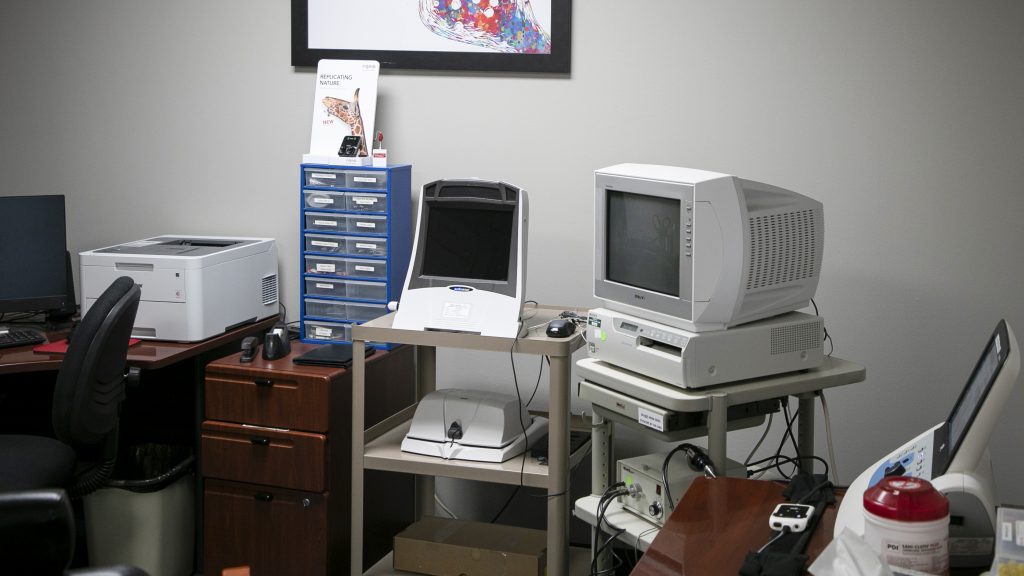

Children with Autism Spectrum Disorder, also referred to as ASD, can now receive specialized testing and intervention from UNT’s Speech and Hearing Clinic which can help them hear.
The clinic joins Hearts for Hearing in Oklahoma and the University of Melbourne in Australia as a recipient of a grant from Sonova USA Inc. which allows them to provide testing specifically for children with autism.
“I’ve worked with [Sonova] probably for the last 15 years, mostly on technology for kids with hearing loss,” Dr. Erin Schafer said, who oversees the clinic. “Around 2011, they asked if I was interested in seeing if their technology would help children with ASD. Since then we’ve published four or five studies and now we are moving into an actual clinic.”
Schafer said the clinic offers testing one day a week and can expand if necessary.
“We have four appointments slots each Thursday,” Schafer said. “I think so far we’ve had about eight total appointments, and we will add days if we need to.”
Schafer said they accept insurance but most companies don’t cover the cost of this service.
“The full testing cost between four and 600 dollars,” Schafer said. “The device consultation usually costs $150.”
The clinic offers two forms of appointments – auditory processing evaluations and device consultations.
“We test their ability to repeat back what they hear in the presence of background noise, which is very common and typical classrooms,” Schafer said. “We also try to look at whether or not the ears are working equally. Our brain is so amazing and it can combine the information from the two ears to help us hear better. But if each year is not working to its potential, you’re not able to to combine that information effectively.”
Schafer said kids receive a typical hearing test during the process, but it also goes deeper than that.
“Our main focus is beyond just the cochlea or the inner ear, and we want to assess the processing, which is more in the brain,” Schafer said.
Despite the advanced techniques, Schafer said the tools needed are quite simple.
“Usually they’re either wearing headphones, and it’s through the computer, or they sit in a sound booth and we ask them to repeat what they hear whether it be to both ears or in one ear,” Schafer said.
The other testing deals with how well children can communicate and listen in noisier environments.
We also look at their listening skills in everyday environments,” Lauren Mathews said, who also oversees the clinic. “[We want to know] how they do in classrooms, restaurants and what behaviors do they exhibit.”
When the test results come in, the clinic decides which one of the three specific methods of intervention is best for the child.
One of the intervention methods is the use of remote microphone technology; a device that is similar to a hearing aid, just without the microphone. The child puts it in their ear and it connects to remote microphone that their teacher or parents carry. But instead of amplifying sound, it simply transmits it directly to their ear. This makes it seem like they are being spoken to directly no matter the noise level.
“If I was wearing the receiver and Lauren was my teacher or parent, she would wear the microphone and it would take the signal from her and put it directly in my ears at a comfortable volume,” Schafer said. “It works the same whether I’m right beside her or in the hallway.”
The other two forms are speech-in-noise training and computerized-listening technology, which helps children improve their listening.
“What the computerized training does is help both sides of the brain process information equally,” Mathews said.
The clinic’s action has not gone unnoticed. One student said she knows how autism affects people and is happy UNT is providing assistance.
“Growing up with an autistic brother was hard at times because he couldn’t do what everyone else could,” broadcast journalism senior Sierra Galvez said. “[So] knowing that I chose a university that supports a cause I am very passionate about makes me proud that I picked this school.”
Another student says she hopes this testing shows children that they are special in a good way.
“I believe [the testings] will give kids the understanding that nothing is wrong with them, they just have some characteristics that others don’t,” kinesiology junior Aaliyah Evens said.
Mathews and Schafer said in the future they will combine all the data they have collected to evaluate what measures best suit the children moving forward.
“My number one goal is to help them be able to listen in challenging environments and improve their quality of life in noisy environments,” Schafer said.
Featured Image: Diagnostic equipment used to test for signs of autism are located in UNT’s Speech and Hearing center. Image by Theophilus Bowie