


The wonder of the universe is at your fingertips! Here is how you can use the Almanac to help stargaze and explore the night sky.
A Calendar of the Heavens
Though weather predictions are often the first thing people associate with The Old Farmer’s Almanac, an almanac means a “calendar of the heavens” or a sky timetable.
The calendar pages are the heart of the Almanac, and it was an enthusiasm for astronomy which first inspired our founder, Robert B. Thomas, who would pore over “Ferguson’s Astronomy” as a young boy. He studied the heavens—observing the Moon phases, conjunctions, meteor showers, and other celestial events. His fascination with astronomy resulted in this farmer’s almanac being a true “calendar of the heavens.”
Here are the calendar pages from his very first 1793 edition—revealing all of nature’s precision, rhythm, and glory—and giving readers an astronomical view of the year.
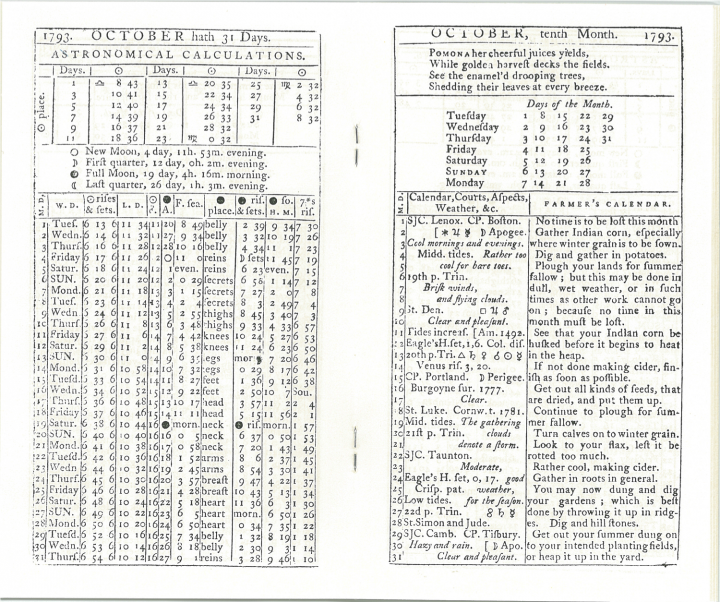
Today, the calendar pages continue to be at the heart of The Old Farmer’s Almanac. They are, in essence, unchanged, and Robert B. Thomas would surely recognize his handiwork here.
Here is an example from the 2017 Almanac:


- At the top left, you see the “Sky Watch” with the significant events in the night.
- This is followed by the month’s Moon phases and, still dominating the page, the columns of numbers that display nature’s rhythm and glory.
- The columns are read horizontally, starting with the days of the year, month and week.
- What follows are the Sun rise and set times, length of day, Sun fast, the declination of the Sun, high tides, the Moon rise and set, the Moon’s age in days, the Moon’s place in astrology (yes, some of the earliest almanacs included astrology and, believe in it or not, it has celestial interest), and the Moon’s age.
A Calendar of Astronomical Events
Beyond the calendar are exacting and exquisite details on a broad range of events in an easy-to-read format. Here are a few examples:
This year’s eclipses and full Moons …
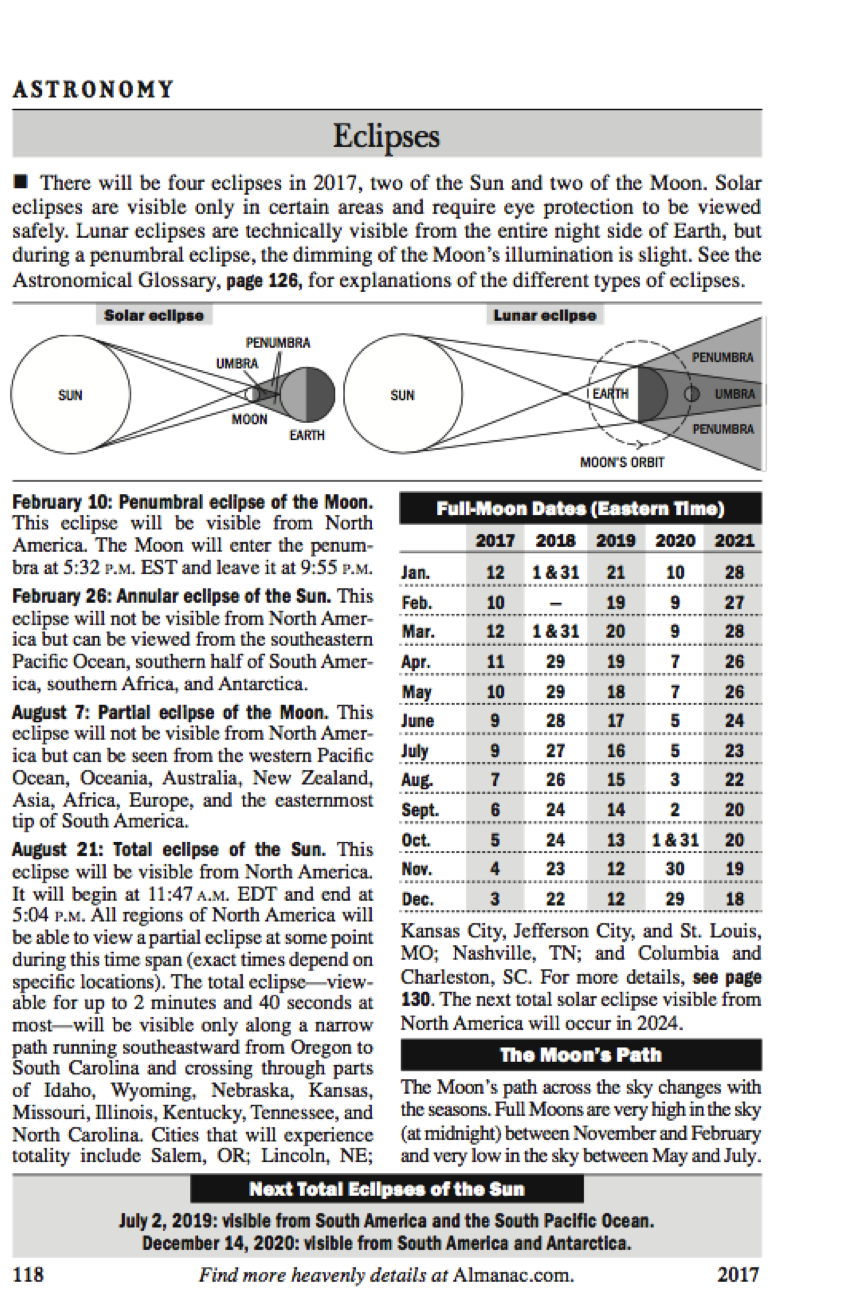
Guidance for calculating twilight and viewing principle meteor showers …

The transit and rise/set times of significant stars …
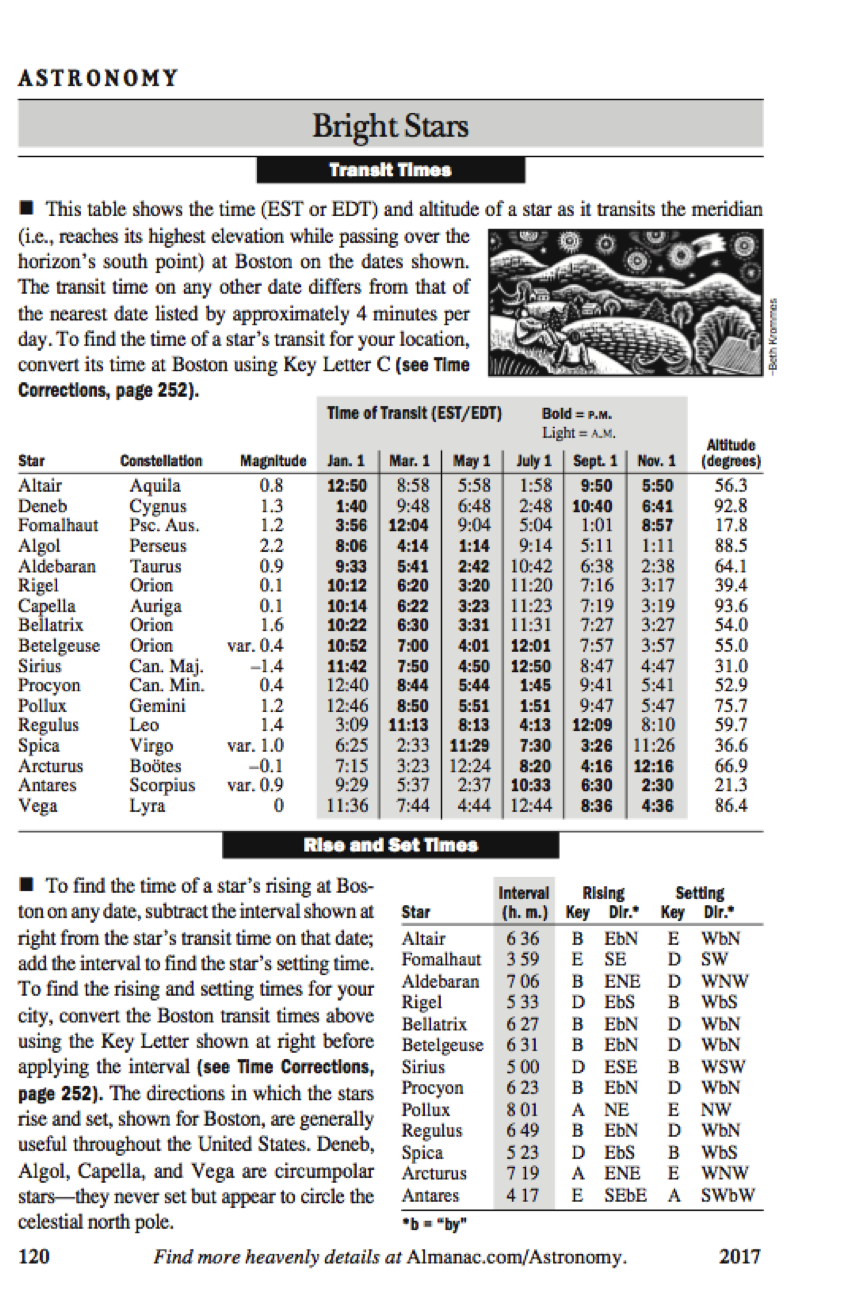
And guidance for viewing the planets …


Your little yellow book is one of the handiest and most reliable tools for viewing and enjoying the wonders of the universe!
Look inside the brand-new 2022 edition of The Old Farmer’s Almanac.
We hope you enjoy exploring the cosmos with The Old Farmer’s Almanac!