

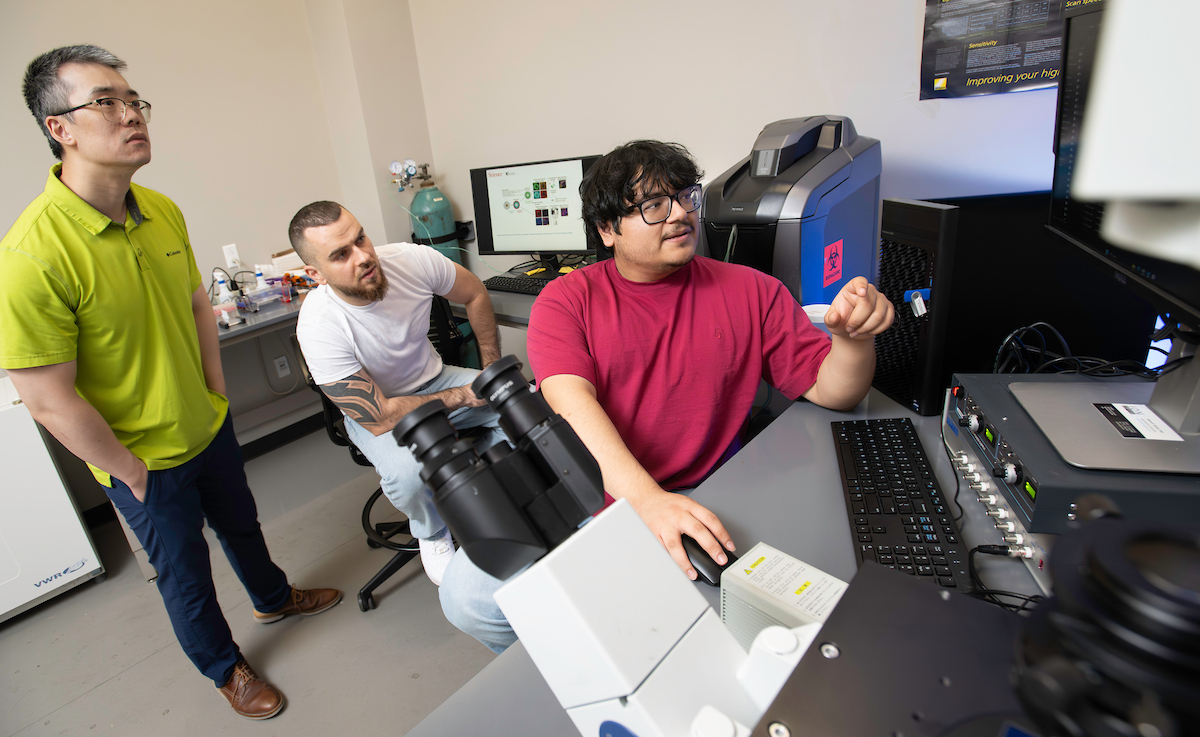

Inside the University of North Texas’s Discovery Park research campus, a team led by Adam Yang, assistant professor in the College of Engineering’s biomedical engineering department, has developed advanced lab-grown artificial organs, known as organoids, that could revolutionize heart treatment testing. These organoids feature a vascularized network, allowing them to simulate real organ functions more precisely.
Yang, who began the project as a post-doctoral researcher at Stanford University in 2017, has continued to evolve the research since joining UNT in 2020. The work has been supported by UNT, Stanford, the American Heart Association, the National Institutes of Health (NIH), and other federal grants.
“Without blood vessels, we could not survive, similar to the organoids,” Yang stated, emphasizing the importance of vascular networks in human organs, which the project has successfully replicated.
Ph.D. student Angello H. Gomez, supported by the NIH G-RISE program, contributed significantly to vascularized cardiac organoid differentiation and data analysis. He highlighted the innovative nature of the project, saying, “It’s groundbreaking because no other work before has built a fully vascularized network in heart and liver organoids.”
Currently, the organoids mimic an embryonic heart about six and a half weeks after gestation and measure around 2 millimeters in diameter. The findings, published in Science, aim to reduce reliance on animal models for drug testing and genetic disease research.
Gomez, driven by personal motivation stemming from a relative’s congenital heart disease, is working on incorporating blood flow simulation in his dissertation to advance understanding and treatment of heart conditions.
The team aims to continue refining their organoids to more accurately reflect human heart characteristics, with aspirations to use them for testing drugs and therapies more safely and effectively.